- Home
- Areas we cover
- Buckinghamshire
Office leak detection in Buckinghamshire
From central Milton Keynes and Aylesbury to High Wycombe, Marlow and Amersham, ADI’s engineers trace hidden water leaks in office buildings across Buckinghamshire and keep the disruption to your staff as small as the job allows.
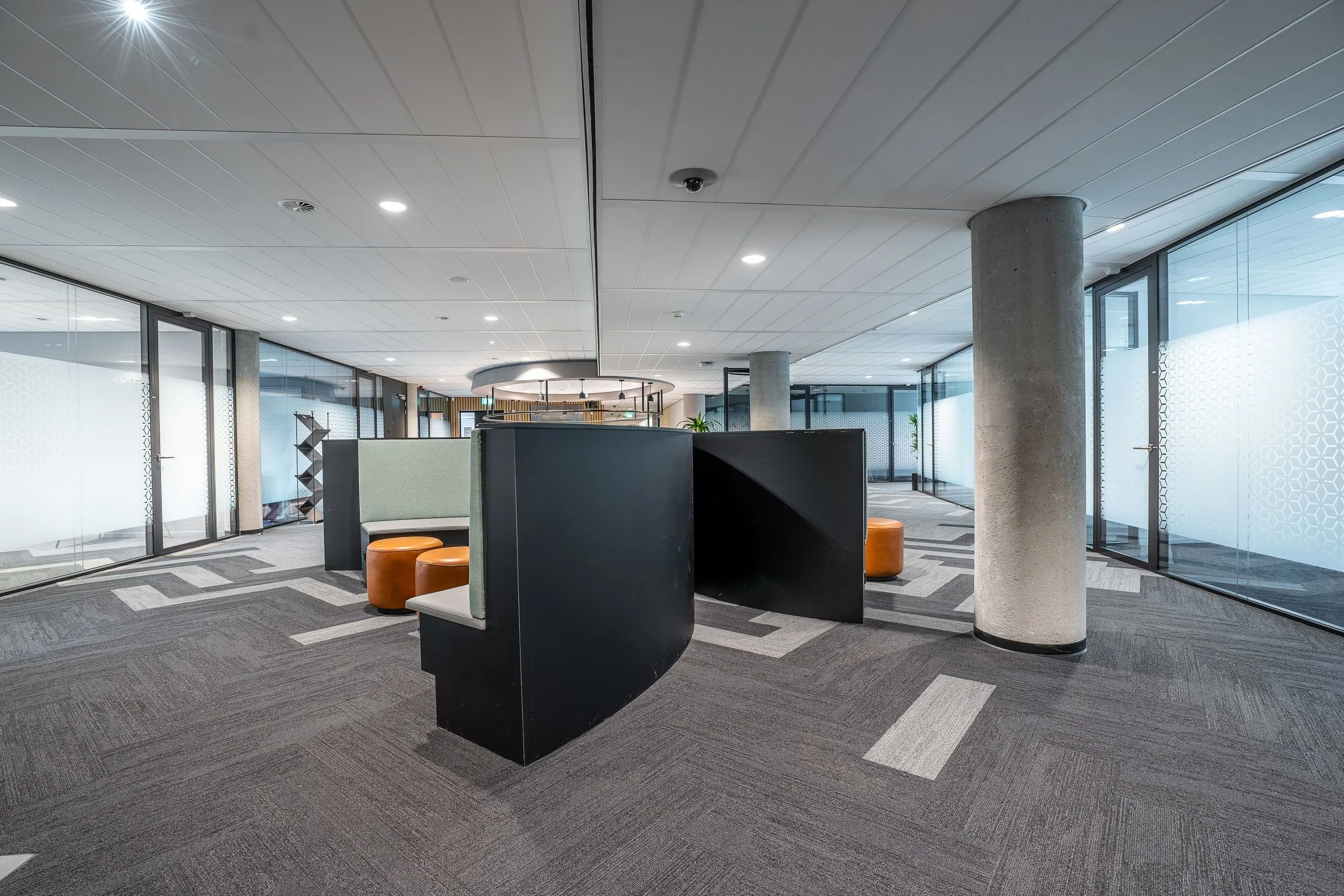
Leak detection services for offices in Buckinghamshire
Six parts of an office building that leak in their own way. Every survey starts non-invasive, and pipework and drainage leaks can be quoted for repair.
Flat roofs, terraces and plant decks
Most office buildings have a flat roof crowded with air-conditioning units, vents, rooflights and a lift overrun, and every one of them goes through the waterproofing.
How it is investigatedWater mains, car park supplies and underground pipes
The supply usually runs from a meter in the pavement or car park, under the tarmac and into the plant room.
How it is investigatedWashrooms, kitchens and tea points
Office washrooms and tea points sit in the same place on every floor, stacked above each other around the core.
How it is investigatedHeating, cooling and hot water
A plant room of boilers and pumps feeds radiators, fan coil units and hot water across every floor, and a leak can sit anywhere along those runs: in a riser, under a floor or above a suspended ceiling.
How it is investigatedRisers, ceiling voids and raised floors
An office hides most of its pipework: up through service risers, across the void above the ceiling grid and, in some buildings, under a raised floor full of cables.
How it is investigatedDrains, basements and lower floors
Soil stacks carry every washroom's waste down through the building, rainwater pipes bring the roof water down beside them, and it all meets in the drains under the lower ground floor.
How it is investigated
How an office leak survey works
Step 1: You call the office
Tell us the postcode, what you have noticed and which floors are affected. The office team will ask about the building, the supplies and access, and give you current availability and a quote.
Step 2: We agree access and timing
Engineers need every relevant area, including plant rooms, risers, the roof and any other tenant's space on the same supply. Tell the office about building rules, sign-in and lift access.
Step 3: The engineer arrives
A risk assessment and method statement are supplied for commercial work. The engineer meets your building contact and looks at the meter, stopcocks and plant room first.
Step 4: The survey narrows it down
Pressure testing separates the circuits. Thermal imaging, moisture mapping, acoustics, tracer gas and cameras then close in on the leak. Some tests need the water or heating off for a short while.
Step 5: You get the findings in writing
A report with photographs, findings and recommendations, written so it can go straight to an insurer, a landlord, a managing agent or a contractor.
Step 6: Repair where it is quoted
Pipework and drainage leaks can be quoted and repaired, often on the same visit, and pressure tested afterwards. Roof and building-fabric leaks are located and reported for a roofer to fix.
Non-invasive water leak detection methods
ADI’s engineers combine these seven methods to locate hidden leaks before opening the affected area.
Tracer gas
A safe, non-flammable gas goes into the pipe and a detector finds where it escapes at the surface.
In an office building: Pipes under car parks, pipes in screed, flat roofs.
Acoustic listening
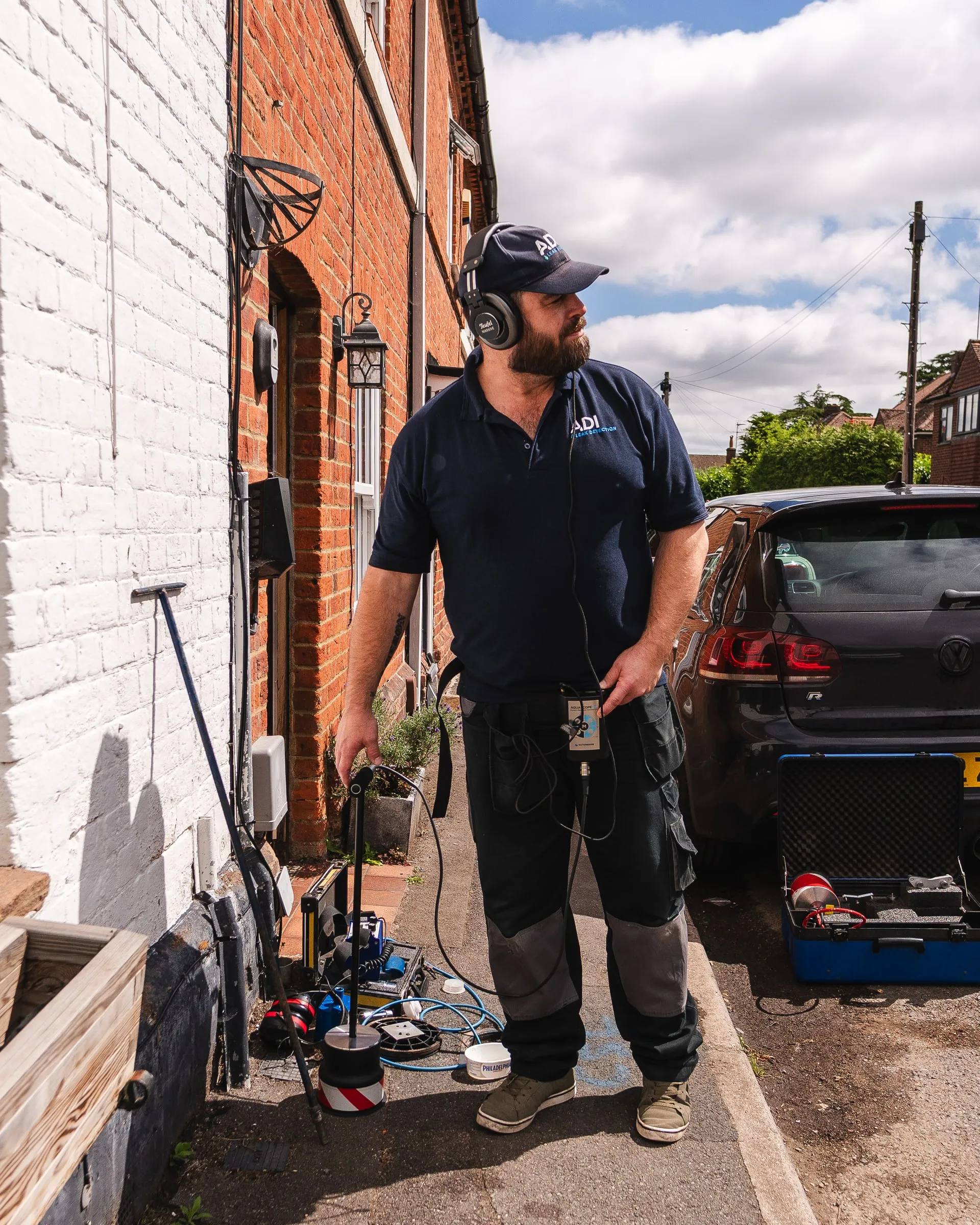
Sensitive microphones pick up the sound of water escaping under pressure.
In an office building: Buried supply pipes and risers, best when the building is quiet.
Leak-noise correlation
Sensors on either side of the leak work out how far along the pipe it sits.
In an office building: Long supply runs under car parks and business parks.
Thermal imaging
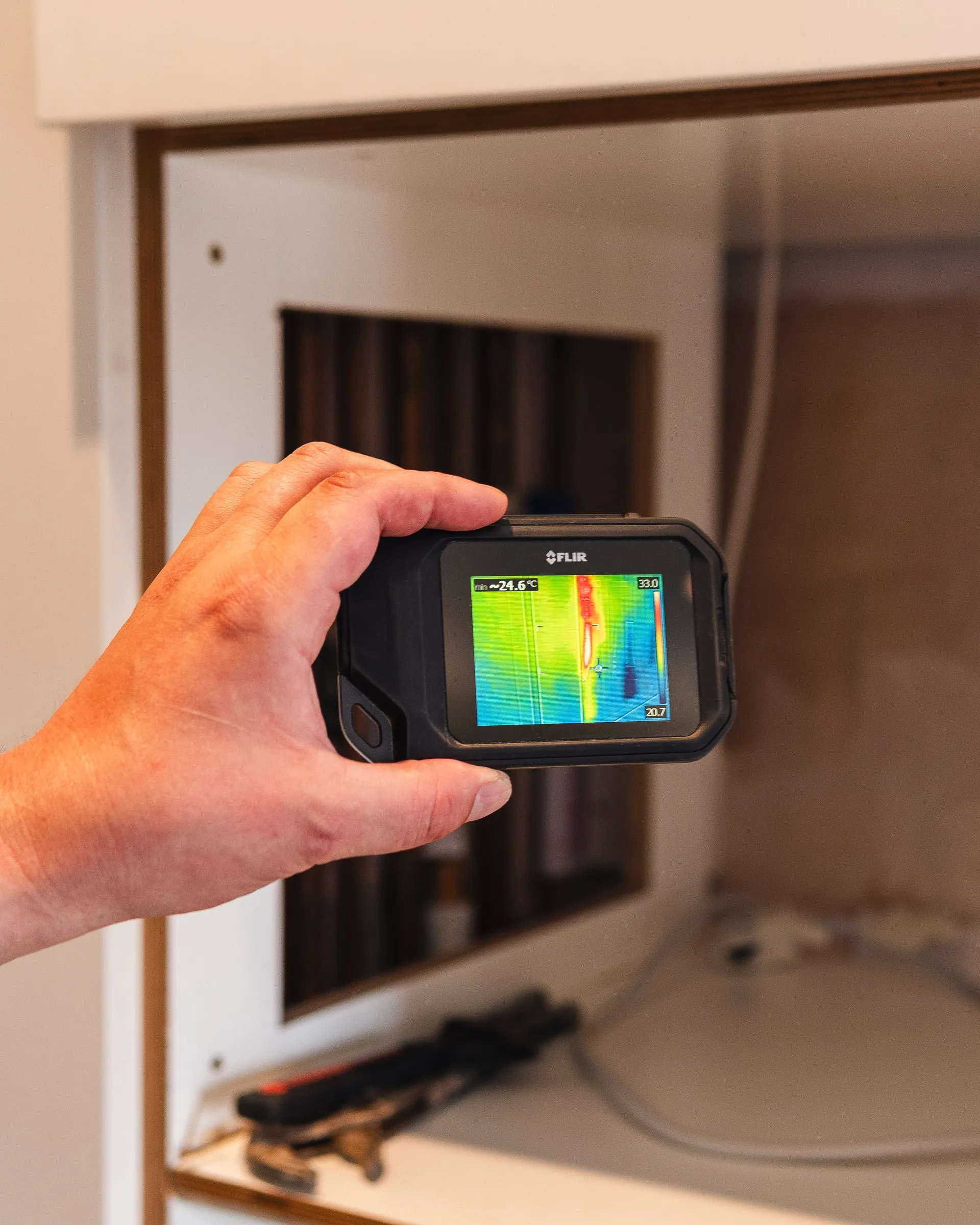
A thermal camera shows warm pipes and cold, wet patches behind walls, floors and ceilings.
In an office building: Heating pipes, runs across ceilings, and flat roofs by drone.
Borescope cameras
A camera on a flexible tube looks inside a void through one small hole.
In an office building: Ceiling voids, risers and boxed-in washroom pipes.
Moisture mapping
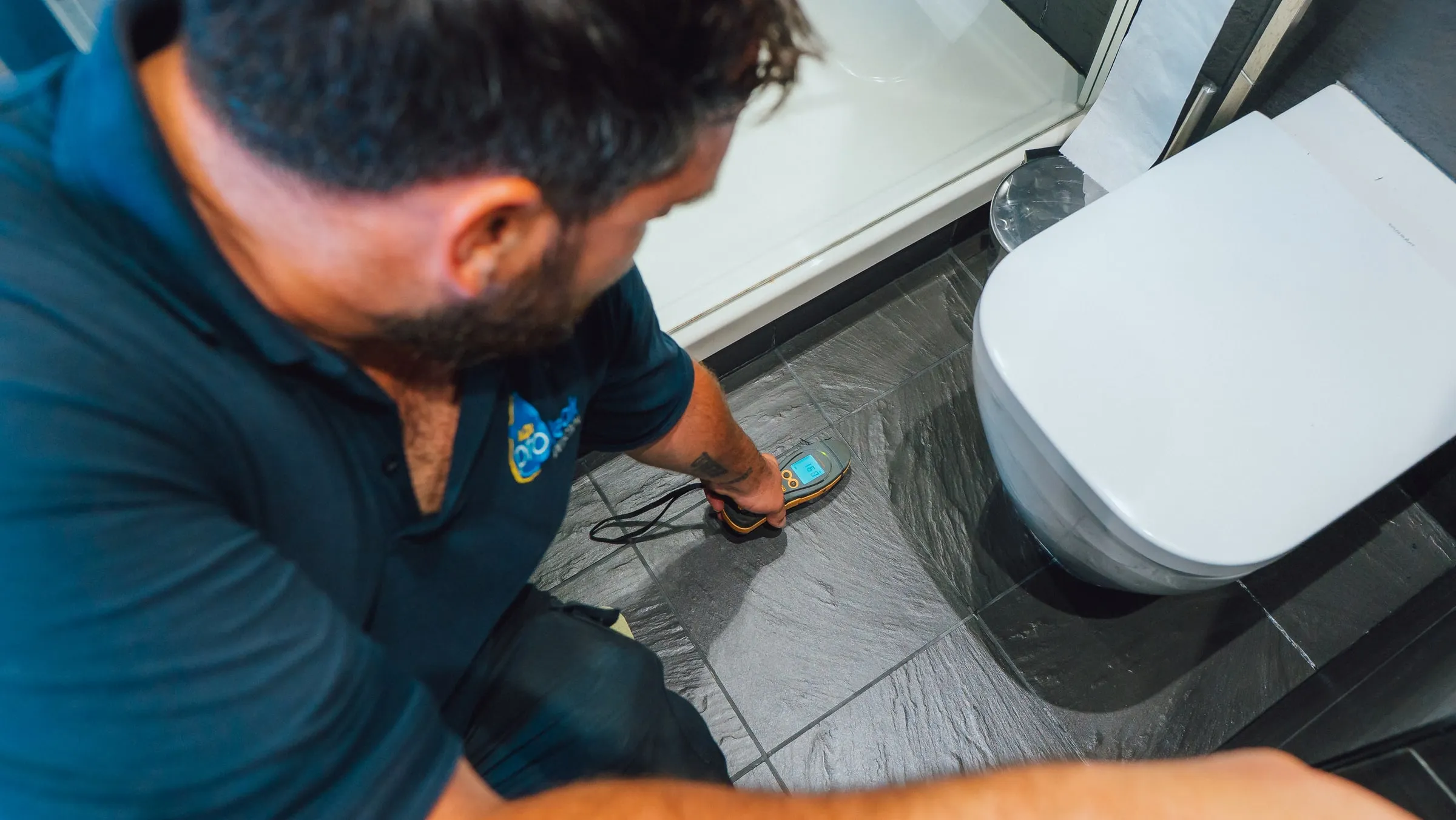
Meters map how wet walls and floors are, showing where the water started.
In an office building: How far water has spread across a floor or a run of ceiling tiles.
Pressure testing
Each circuit is held under pressure. A drop confirms a leak; a steady gauge proves a repair.
In an office building: Separate supplies for each floor or tenant.
Areas we cover in Buckinghamshire
Our engineers cover the whole of Buckinghamshire, including the City of Milton Keynes. The towns below are examples of where we work, not a complete list, so call with the postcode wherever the building is.
Milton Keynes and the north
- Milton Keynes
- Bletchley
- Wolverton
- Newport Pagnell
- Olney
- Buckingham
- Winslow
Much of the office space around Milton Keynes was built with the new city from the 1970s onwards: business parks off the grid roads, larger blocks in the centre and low-rise units sharing one car park. On sites like these the supply pipe can run a long way under tarmac, so a meter turning overnight is often the first sign.
Aylesbury and mid Buckinghamshire
- Aylesbury
- Wendover
- Princes Risborough
Here you find larger town-centre office blocks alongside offices above shops and small business units in the market towns. In a mixed building the water often starts in someone else’s washroom or kitchen, and the report has to show exactly where.
High Wycombe, Marlow and the south
- High Wycombe
- Marlow
- Bourne End
- Beaconsfield
- Gerrards Cross
- Burnham
- Taplow
- Iver
Along the M40 and towards the M4 there are business parks, serviced offices and multi-let blocks where several companies share one incoming supply. Tracing a leak there usually means access to other tenants’ floors, so it helps to bring the landlord or managing agent in early.
Amersham, Chesham and the Chilterns
- Amersham
- Chesham
Older buildings in the historic town centres, many now used as offices, sit alongside newer offices nearer the stations. Where a building is listed or has finishes that are expensive to replace, finding the leak before anything is opened matters most.
This page follows the ceremonial county: the Buckinghamshire Council area plus the City of Milton Keynes. A few places inside the county, such as Taplow and Iver, have Maidenhead or Slough postcodes. Town names checked against OpenStreetMap on 15 September 2026 (© OpenStreetMap contributors).
Office buildings we work in across Buckinghamshire
The kind of building changes who needs to be involved and how the leak is traced.
Multi-let office buildings
Several companies on one supply, with the landlord or managing agent responsible for shared pipework. Access to other floors is planned before the visit.
Business park offices
Low-rise buildings round a shared car park, where the incoming main can run a long way under tarmac before it reaches the plant room.
Serviced and co-working offices
Busy kitchens, showers and washrooms on every floor, and members who need the space open while the survey happens.
Offices above shops
Mixed-use buildings where water from an upstairs washroom can show up in the shop below, or the other way round.
Older and converted buildings
Pipes buried in floors and walls through years of refits, where finding the leak first saves opening up finishes that are costly to replace.
Company headquarters
Larger buildings with plant rooms, risers and roof plant, and a facilities team who needs a report the insurer and the board can both use.
- Trustpilot TrustScore
- 4.7
- Reviews
- 1600+
- Engineers nationwide
- 25+
- Public liability insurance
- £5m
What customers say about ADI on Trustpilot



Read the full review“He was able to locate the leak and provided a detailed report that could be shared with my insurer.”
Read the full review“He quickly set up the equipment, carried out a tracer gas test and pinpointed the leak to an area just outside our garage underneath the driveway.”
Office leak detection questions in Buckinghamshire
Do you cover the whole of Buckinghamshire, including Milton Keynes?
Yes. ADI’s engineers cover all of Buckinghamshire, the City of Milton Keynes included, as part of coverage across England, Scotland and Wales. The towns on this page are examples. Call with the postcode and the office will confirm availability.
Is ADI based in Buckinghamshire?
ADI Leak Detection’s office team works from High Wycombe, and the company’s registered office is in Bourne End. The engineers are based across the regions, so the office will tell you who is available when you call. We do not promise arrival times on a website.
Can you look at more than one of our offices in the county?
Yes. Tell the office about each building when you call so the visits can be booked. Businesses with several offices can use one provider and get the same report format for every building.
What if the office is in an old or listed building?
The survey starts non-invasive, which helps in any building where opening up floors, walls or ceilings is costly or needs permission first. Tell the office if the building is listed or has finishes that must not be damaged, so the engineer can plan the visit around it.
What if the leak is coming from another tenant or the floor above?
In a shared building it often is. Water travels through ceiling voids and risers, so the stain in your office can start in a washroom upstairs, a neighbouring unit or the landlord's pipework. The engineer needs access to those areas too, so let the landlord or managing agent know before the visit. The report says where the leak actually is, with photographs, which gives everyone the same facts when working out who arranges the repair.
Call about a leak in an office in Buckinghamshire
Give the office the postcode, the floor and what you have noticed. They will talk through the survey, give you a quote and current availability, and book the engineer.
- Monday to Friday, 7:30am to 6:30pm
- Calls reach ADI Leak Detection's office in High Wycombe. Engineers cover England, Scotland and Wales.